Experimental Friction losses in pipes are estimated by Darcy-Welsbach formula as. This is due to the fact that in turbulent flow a thin viscous layer is formed near the pipe surface which causes a loss in energy while in laminar flow this viscous layer is non- existent.

Pipe Friction Loss
Pipe line introduces extra friction in addition to normal friction due to the walls of the pipe.
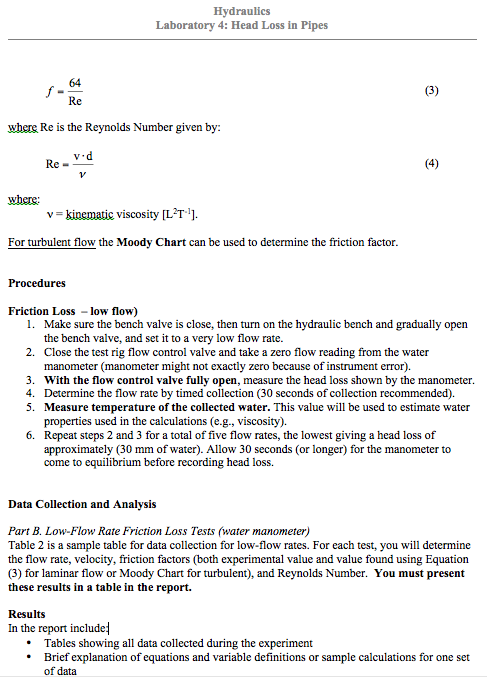
. Head loss Due to Sudden Changes in Area of Flow. Students who viewed this also studied. This is due to the fact that in turbulent flow a thin viscous layer is formed near the pipe surface which causes a loss in energy while in.
When a fluid is flowing through a pipe it experiences some resistance due to which some of energy head of fluid is lost. Minor head losses can be defined as the energy lost due to fixtures such as bends and valves present in the system while major head losses are defined as losses of energy due to the frictional resistance which acts against the flow of the fluid which can be calculated using the following formula which is known as the Darcy-Weisbach equation. Friction loss is the loss of energy or head that occurs in pipe flow due to viscous effects generated by.
H f LV gd f hgd L LV 2 L 2 2 2 3 where f is a dimensionless constant ie. Theory Losses in pipe networks could be divided typically into major and minor losses. Lab 5 - Friction Loss in Flow through Pipesdoc.
Lab 5 - Friction Loss in Flow through Pipesdoc. AbstractThe purpose of the experiment is to study the differences of roughness valves and geometries of pipe and how they influence friction losses. Major head loss is caused by the frictional force in the straight pipe and minor head loss is caused by the loss coefficient of the various pipe fittings.
Points for pipe loss study are taken at a certain distance apart with a manometer provision to study pressure loss due to friction. A gate valve provides friction to the flow of the fluid in a pipe. Energy loss through friction in the length of pipeline is commonly termed the major loss h.
FRICTION LOSSES IN STRAIGHT PIPE - Free download as Word Doc doc PDF File pdf Text File txt or read online for free. Friction Losses Lab Report - Fluids. Friction Losses Lab Report Fluids.
Frictional loss is measured Piezometer tappings are made at an upstream section which lies approximately 45 tube diameters away from the pipe entrance and at a downstream section which lies approximately 40 tube diameters away from the pipe exit. Energy losses in pipes used for the transportation of fluids water petroleum etc are essentially due to friction as well as to the diverse singularities encountered. Energy equation- 𝑝1 𝑦 𝑣1 2 2𝑔 𝑧1 𝑝2 𝑦 𝑣2 2 2𝑔 𝑧2 ℎ𝑓 V1V2 constant.
Formulation Head loss hL is directly proportional to the Pipe frictional constant f Length of the pipe L in m. For a long pipeline on the other hand skin friction at the pipe wall. Similarly the entry losses were lower 123 m than.
Lab Report 2 pipe flow lab report connor 13295910 matthew 13295934 nazmus 12632877 sam 13356706 table of contents abstract introduction methodology experimental. Major losses occur due to friction within a pipe and minor losses occur at a change of section valve bend or other interruption. Friction factor which is a function of the Reynolds number of the flow and the roughness of the internal surface of the pipe.
These clear lengths upstream and downstream of the test section are. The apparatus consist of pipes with common inlet connection provided with control valve to regulate the flow. In the lab we observed the effects of pipe friction and minor losses due to different flow rates through different pipe sizes.
Fluid Mechanics Lab Report. Study the Pipe Flow in both Laminar and. AbstractThe purpose of the experiment is to study the differences of roughness valves and geometries of pipe and how they influence friction losses.
The energy required to push water through a pipeline is dissipated as friction pressure loss in m. Which is the loss of head due to pipe friction and to viscous dissipation in flowing water. In this practical you will investigate the impact of major and minor losses on water flow in pipes.
Major Losses are produced mainly due to friction or viscous action while miner losses are due to valves bends elbows sudden expansion or contraction etc. Where there are numerous fittings and the pipe is short the major part of the head loss will be due to the local mixing near the fittings. Loss of head is incurred by fluid mixing which occurs at fittings such as bends or valves and by frictional resistance at the pipe wall.
Conclusion This lab showed us that fluids traveling through pipe systems result in pressure losses because of friction. Fluid Mechanics Lab Report. This energy drop is dependent on the wall shear stress τ between the fluid and pipe surface.
In experiment 1 it can be concluded that as the mean velocity of the fluid increases the head loss increases. Experiment conditions With turbulent pipe flow where the flow is considered steady at Reynoldss numbers of Re 2320 pressure loss is proportional to the - length l of the pipe - Coefficient of pipe friction λ - Density p of flowing medium - Square of the flow speed v In addition the pressure loss increases as the pipe. The results in Figure A2 show that the loss in Q due to the gate valve was the lowest 5 m and that due to exit loss was the highest 25 m at Q of 40 m3h.
Fluid friction in pipes lab report Skip to content For turbulent flow the pressure drop is dependent on the roughness of the surface while in marina flow the roughness effects of the wall are negligible. Friction loss is the loss of energy or head that occurs in pipe flow due to viscous effects generated by the surface of the pipe. LAB REPORT ENERGY LOSSES DUE TO FRICTION IN A CYLINDRICAL PIPE INTRODUCTION The flow of fluid in a pipe is accompanied by the loss of energies as a result of the interaction between the fluid and the viscous stresses on the wall of the pipe.
Objective of the Lab We need to experimentally study the pipe flow in both laminar and turbulent flow regime. L V2 h Lmajor f D 2g Where f is the friction factor l is the. Objective is to arrive at pipe roughness numbers and compare them with literature.
For turbulent flow the pressure drop is dependent on the roughness of the surface while in marina flow the roughness effects of the wall are negligible. The head loss along a length L of straight pipe of constant diameter d is given by the expression.
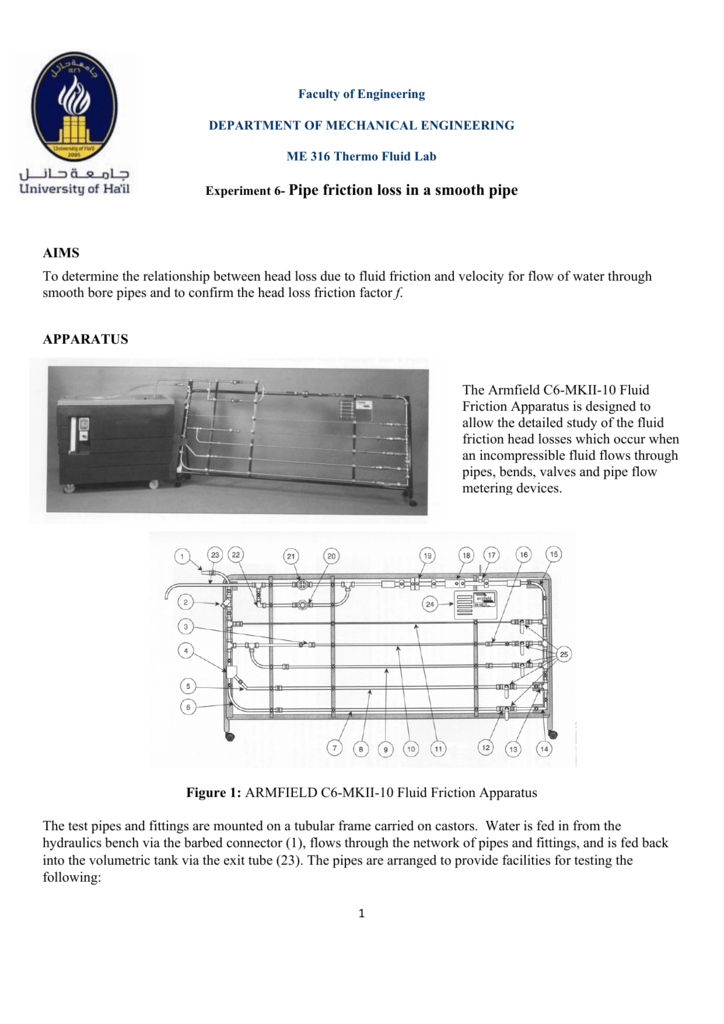
Experiment 6 Pipe Friction Loss In A Smooth Pipe
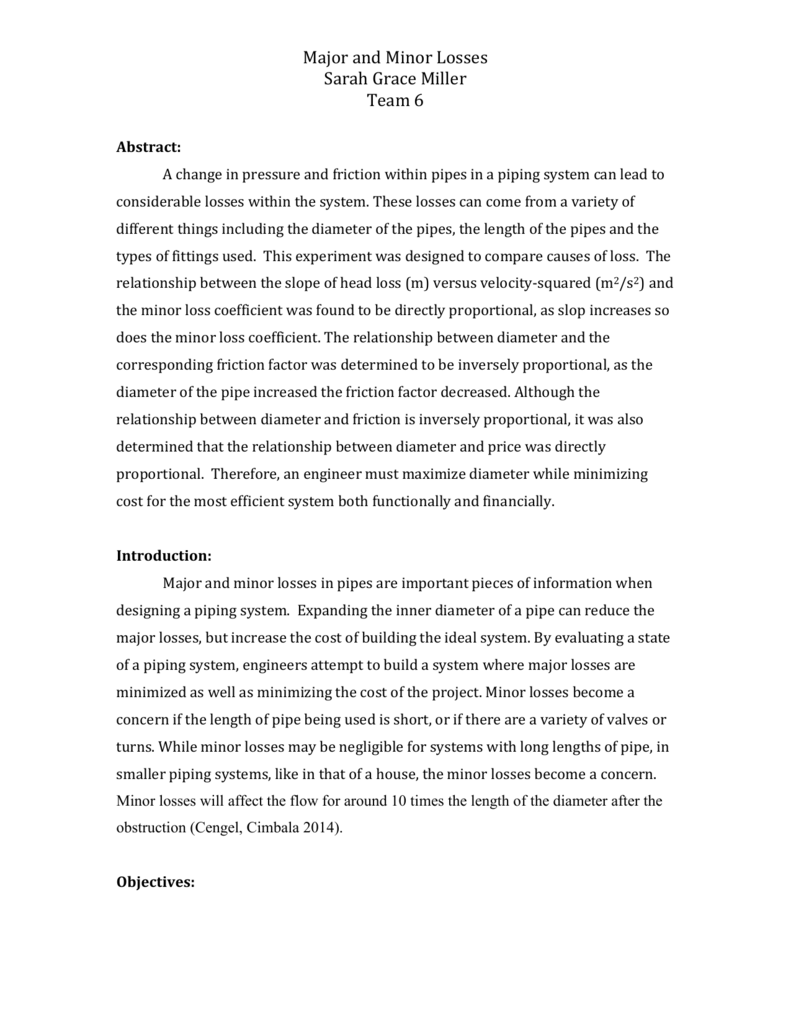
Major And Minor Losses Report
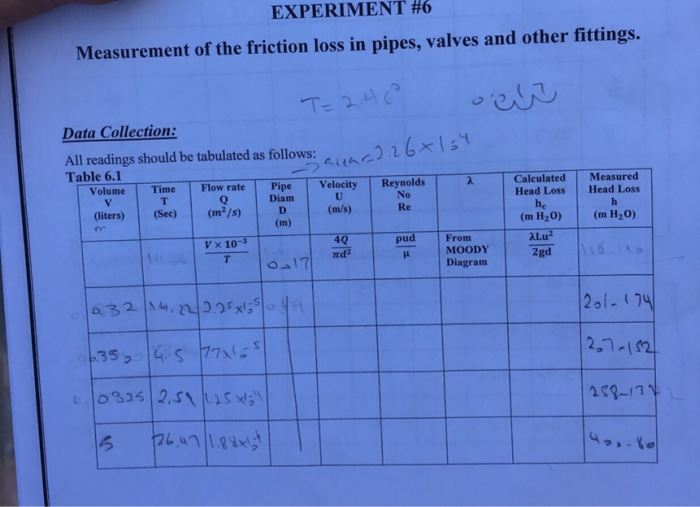
Experiment 6 Measurement Of The Friction Loss In Chegg Com
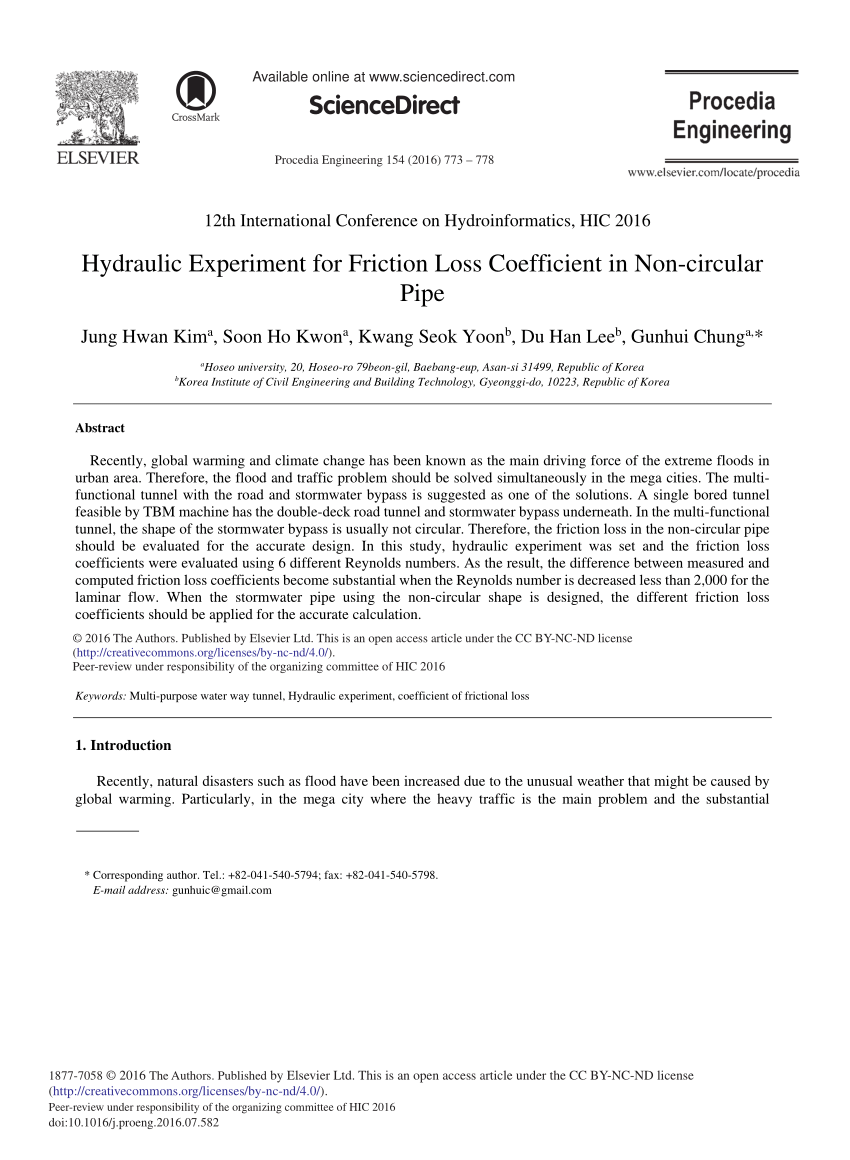
Pdf Hydraulic Experiment For Friction Loss Coefficient In Non Circular Pipe
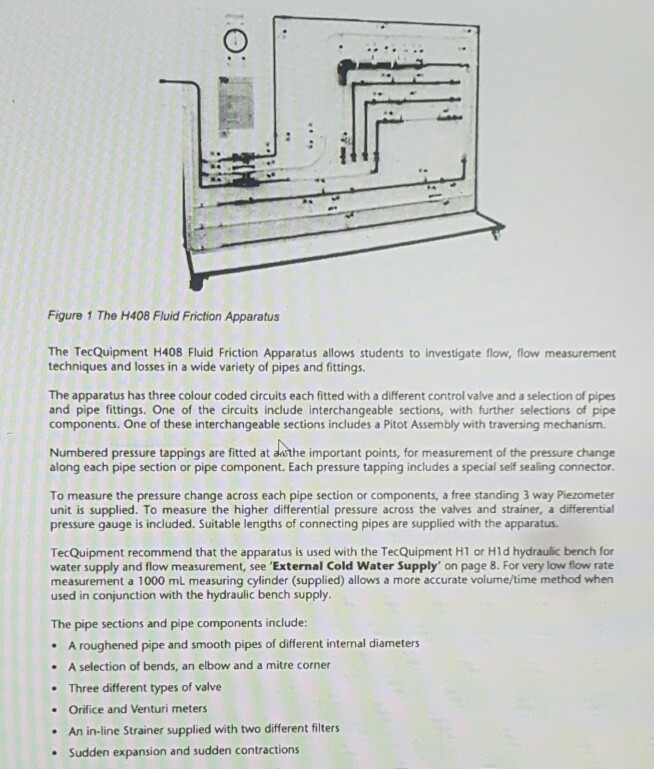
Solved Hi I Am Doing Lab Report Of Head Loss In Straight Chegg Com

The Main Uncertainty When Calculating Head Loss Using The Manometer Is Course Hero
Solved Hydraulics Lab Only Need The Calculation Part Step Chegg Com
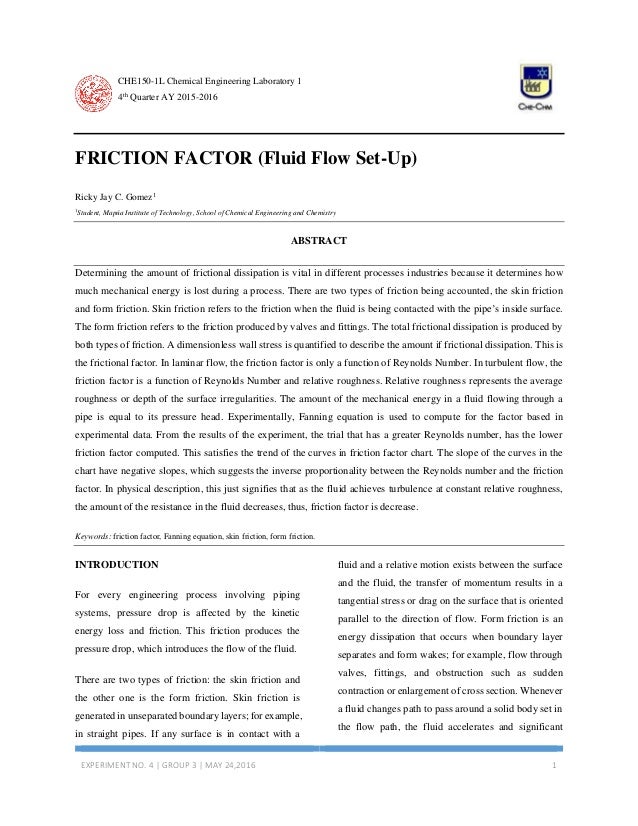
Experiment 4 Friction Factor

Friction Losses In Straight Pipe Pdf Reynolds Number Fluid Dynamics

Doc Mec2404 Frictional Flow In Pipe Lab Report Done By Md Kabir Academia Edu
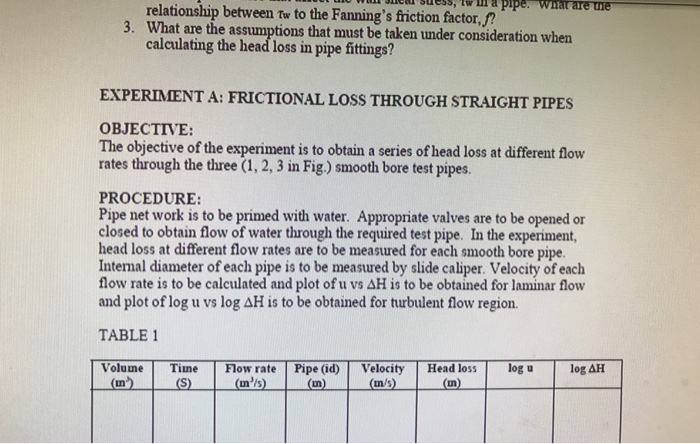
Solved Relationship Between Tw To The Fanning S Friction Chegg Com

Major And Minor Losses

Air Flow In Pipes Lab Report Bashir Emmanuel Academia Edu

Experiment 1 Friction Losses In Pipes Report Doc Document

Experiment 4 Energy Loss In Pipes Applied Fluid Mechanics Lab Manual
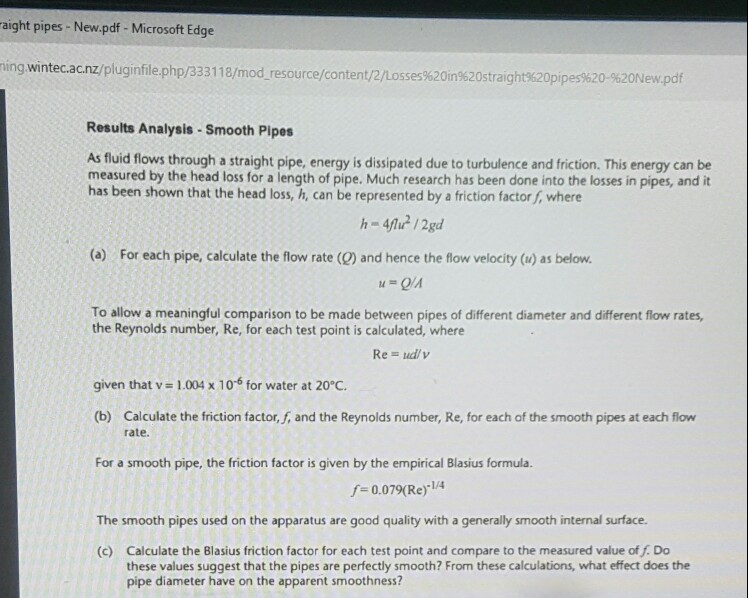
Solved Hi I Am Doing Lab Report Of Head Loss In Straight Chegg Com

Friction Loss In A Pipe Tecquipment
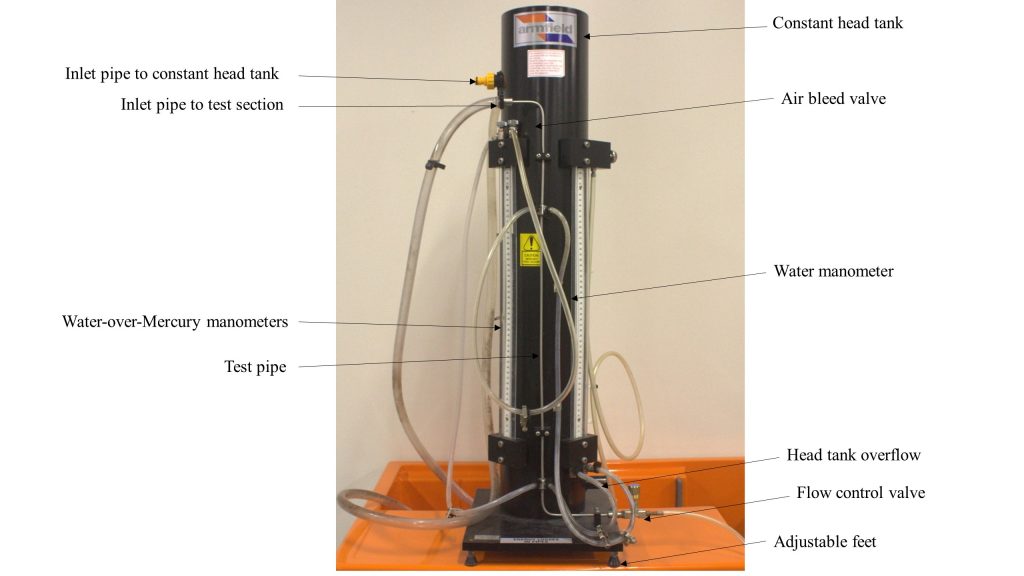
Experiment 4 Energy Loss In Pipes Applied Fluid Mechanics Lab Manual

Friction In Pipes Lab Report
